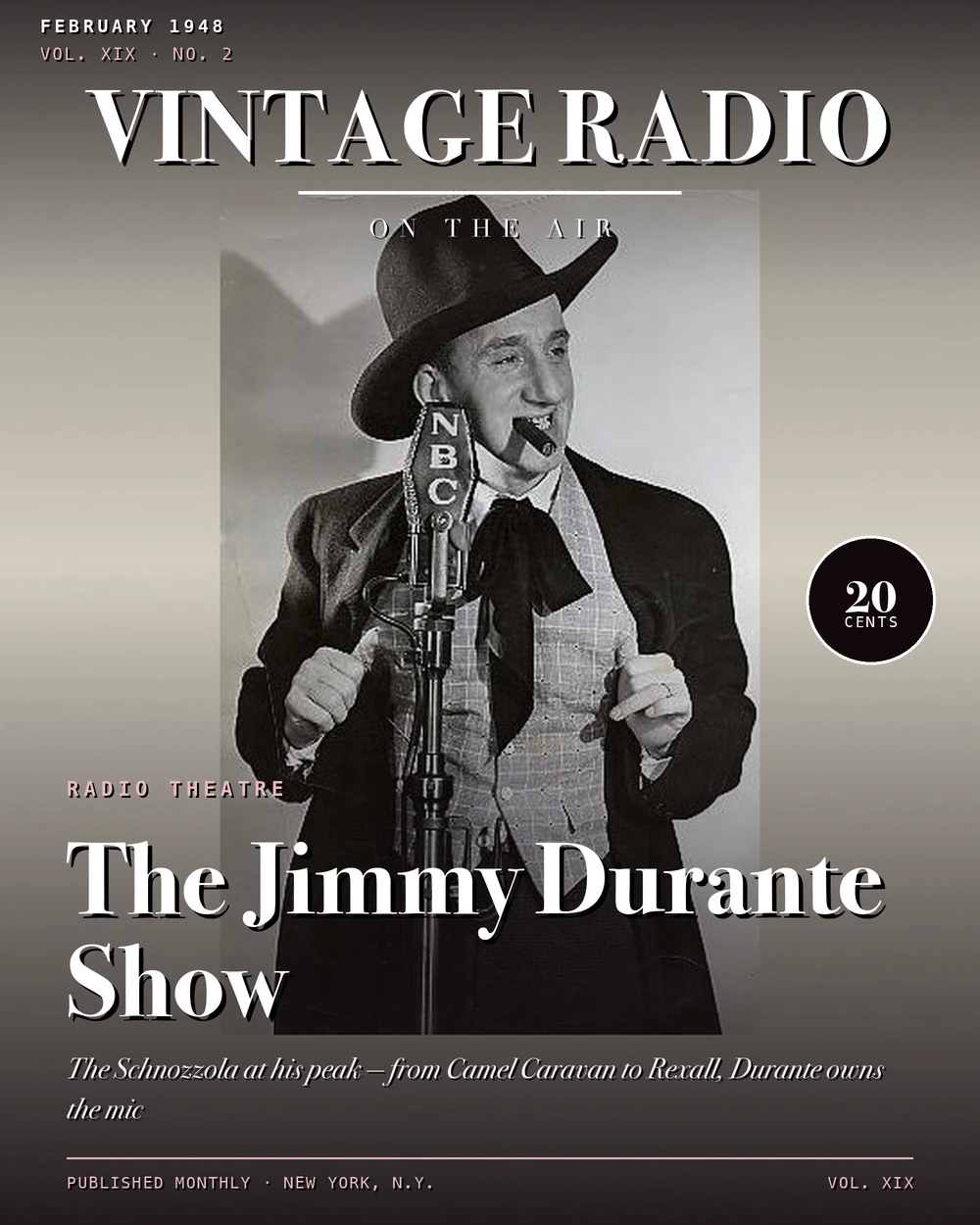
The Jimmy Durante Show
How a Vaudeville Man Found Radio
Jimmy Durante's path to radio was anything but straight. Born on February 10, 1893, on New York's Lower East Side, he learned piano at seventeen and started his musical life in the beer gardens of Coney Island, earning twenty-five dollars a week. He played at Terry Walsh's club while a young waiter named Eddie Cantor sang for tips. By 1916 he had a small Dixieland combo at Harlem's Club Alamo, where he met Eddie Jackson. In 1923, Durante and Jackson opened the Club Durant and brought in a third partner, Lou Clayton — and when Prohibition agents shut the place down, the trio headed for Broadway, arriving in 1928. Their formal partnership dissolved in the 1930s, but Jackson and Clayton stayed close to Durante for the rest of his life, eventually managing his business affairs.
Radio came for Durante in 1933, when he stepped in as a substitute for Eddie Cantor on NBC's Chase and Sanborn Hour. He inherited the show nearly intact — a full sixty-minute format, an audience share in the forties, the music of "Rubinoff and His Violin," with Jimmy Wallington announcing. The Cantor audience raised Durante's celebrity, but he couldn't hold those numbers. Then in 1935 he was installed in the Texaco Fire Chief slot vacated by Ed Wynn, fronting an extravagant production described as beyond anything radio had yet attempted. By January 1936 it was registering a 4.1 in the ratings, and it was gone by the end of February. A string of second-rate films followed, his star cooled, and when his wife Jeanne died in February 1943 he was, by most accounts, financially strapped and at loose ends.
The Durante-Moore Partnership
What rescued him was a chance encounter. That spring, Durante was booked onto NBC's Camel Caravan for what was meant to be a single guest appearance, just before he was set to open at the Copacabana in New York. On that same bill was a young comic named Garry Moore — crewcut, breathless delivery, almost no name recognition outside the business. Moore was being groomed by Camel to take over the timeslot Abbott and Costello had just vacated, after Lou Costello had to temporarily retire due to illness. Producer Phil Cohan watched the two of them together and saw something. He worried about Moore's youth and lack of marquee value, so he proposed a co-billing. The agency agreed. Durante and Moore had never met before that night. The first Durante-Moore show was assembled in two weeks, and reviewers called it a "ragged job."
It didn't stay ragged. The ratings climbed into the mid-teens and stayed there, with an audience that would reach an estimated four million listeners at its peak. The format settled into a comfortable rhythm: Moore served as master of ceremonies, told his own jokes — which he wrote himself — brought Durante on for banter, and introduced vocalist Georgia Gibbs as "her nibbs." Durante, meanwhile, largely ad-libbed through the half-hour. Scripts were prepared by a team of writers who packed in as many multi-syllabic words as Durante could reasonably be expected to mishandle in thirty minutes. Writer Jackie Barnett told Durante biographer Gene Fowler that the word-mangling was entirely natural — if writers deliberately distorted a word, Durante would straighten it out in delivery. So they wrote straight and let him do the work. They wrote "catastrophe" and Durante said "catastrostroke." They wrote "corpuscles" and he said "corpsuckles." In a 1944 interview, he explained his approach simply: he "mangled da big woids just ta hear 'em scream."
Durante referred to Moore as "Junior" and chanted "Dat's my boy dat said dat" so regularly that many listeners came to believe the two were actually father and son. Moore played characters with names like Murgatroyd Croomsboogle, Toodles Bongschmook, and Comastalk Pilderdrentch. Comedy sketches drew on occupational premises — running a circus, becoming scientists, working an oil pipeline — and a recurring segment called the "Garry Moore Radio Workshop" tackled wartime scenarios like the servant problem, the meat shortage, and censorship. Durante's old drummer Jack Roth, who had been with him for twenty-five years, became part of the radio operation. So did Lou Clayton and Eddie Jackson, who joined the business end.
The Show on Its Own
Garry Moore left in 1947. Biographer Gene Fowler described it as an "honest separation" — Moore needed to keep his own identity as a comic rather than stay anchored to someone else's. The show continued for three more years under the simpler banner of The Jimmy Durante Show, with Phil Cohan staying on as producer-director and Durante billed as "Rexall's prescription for a pleasant evening."
The post-Moore cast filled out around Durante's particular kind of chaos. Arthur Treacher played his "butler," with the quotation marks very much implied. Victor Moore, billed as "the Lothario of the lumbago set," was a regular abettor. Florence Halop played Hotlips Houlihan in a broad Mae West style — a character later cited as the namesake inspiration for the Hot Lips Houlihan of MAS*H. Candy Candido's voice could swing from extremely high to extremely low; on the low end, he played a character named Tyrone Touchbottom. Vocalist Peggy Lee appeared during the 1947–48 NBC run, and announcer Howard Petrie and maestro Roy Bargy were steady fixtures. Guests in the heavier rotation included Bing Crosby, Boris Karloff, and Charles Boyer. Former football star Tommy Harmon offered gridiron picks during football season.
Durante opened each week attempting "Inka Dinka Doo," which had become his musical calling card going back to the Durante-Moore days — though he seldom got beyond a line or two before something interrupted him. His catchphrases were fixtures: "Ev-ry-body wants ta git into da act!" landed whenever the sketch got crowded, and after applause he'd follow with "I got a million of 'em!" Songs drew on Durante's older material, including numbers in the style of "I Know Darn Well I Can Do Wit'out Broadway, but Can Broadway Do Wit'out Me?" He also talked on air about a mythical figure named Umbriago and their supposed exploits together. The numbers held: at the end of the 1947–48 season the show was tied for the number-7 slot on the air, alongside Philco Radio Time and Dr. Christian, and it stayed in the top ten for the rest of its NBC run.
"Goodnight, Mrs. Calabash"
Every show closed the same way. Durante would sign off with the line "Goodnight, Mrs. Calabash, wherever you are!" — delivered with just enough weight to make it feel personal. During his lifetime, Durante would never explain it, though there were suggestions it referred to his first wife. At a National Press Club gathering in 1966, broadcast on NBC's Monitor, he finally said as much: driving across the country years earlier, he and Jeanne had stopped in a town called Calabash whose name she loved, and "Mrs. Calabash" had become his pet name for her. Years later, after his death in January 1980, the second Mrs. Durante would describe the sign-off as a piece of show business invention. Both versions probably contain some truth. It fits the man — someone whose most distinctive qualities looked like accidents but were the product of long, natural instinct.
Why Radio Mattered to Durante
Radio gave Durante a second act at the precise moment he needed one. His run through the Prohibition era had been genuinely solid — the clubs, Broadway shows including Jumbo and Red, Hot, and Blue, a real presence — but the film years that followed had burned off a lot of the goodwill. By 1943 he was, by his own circumstances, starting over. The Camel Caravan booking was supposed to be one night's work. The Copacabana run that followed was a smash. Radio reignited Hollywood's interest in him and helped sustain his name through the rest of the 1940s, until television took over in 1950 with Four Star Revue.
His props were simple: a battered hat, a piano, and an oversized nose that had given him his nickname — "the Schnozz," or "Schnozzola" — coined by Lou Clayton long before any of this. His act was half-sung songs interrupted by one-liners delivered in a growly but cheerful voice. None of it was complicated. What the Durante-Moore years demonstrated, and what the solo run confirmed, was that the act translated to radio because Durante himself translated — the growl, the mangled words, the cheerful aggression toward the English language all worked just as well over a speaker as they had across a nightclub floor.